Introduction
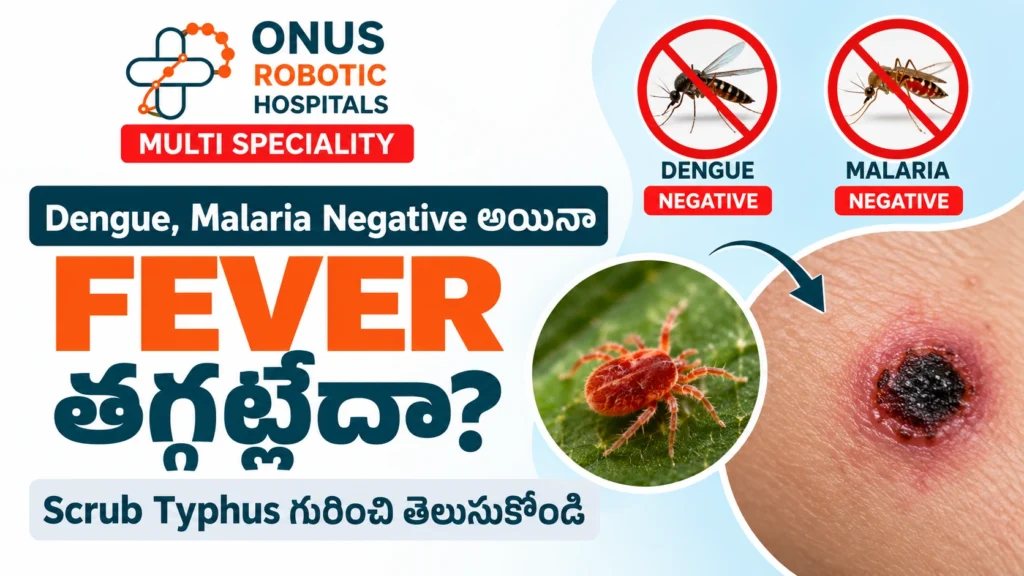
Fever is one of the most common reasons people seek medical attention, especially during the rainy and post-monsoon seasons. When a patient experiences high fever, tests for Dengue and Malaria are often among the first investigations performed. However, there are situations where both Dengue and Malaria tests return negative, yet the fever continues for several days.
In such cases, another important infection that should be considered is Scrub Typhus.
Scrub Typhus is a bacterial infection that can cause prolonged fever and other symptoms that may resemble several common tropical illnesses. Early recognition and timely treatment are important to prevent complications and ensure faster recovery.
At ONUS Robotic Hospitals, Dr. P. Ravi Kiran, Infectious Diseases Specialist, emphasizes the importance of considering Scrub Typhus in patients with persistent fever, especially when routine tests fail to identify the cause.
What Is Scrub Typhus?
Scrub Typhus is an infectious disease caused by the bacterium Orientia tsutsugamushi.
The infection is transmitted to humans through the bite of infected larval mites, commonly called chiggers.
These mites are often found in:
- Bushes and scrub vegetation
- Agricultural fields
- Forested regions
- Rural environments
- Areas with dense grass and vegetation
People who spend time outdoors may have a higher risk of exposure.
Why Is Scrub Typhus Often Missed?
One reason Scrub Typhus is frequently overlooked is that its symptoms are very similar to those of many other infections.
Patients often undergo testing for:
- Dengue
- Malaria
- Typhoid
- Viral fever
When these tests are negative and fever continues, Scrub Typhus may not be immediately suspected.
Awareness among patients and healthcare providers is important for timely diagnosis.
Common Symptoms of Scrub Typhus
Symptoms usually appear within 1–2 weeks after exposure to infected mites.
Common symptoms include:
Persistent Fever
The most common symptom is fever that continues for several days and does not improve as expected.
Severe Headache
Many patients experience intense headaches along with fever.
Body Pains and Muscle Aches
Generalized body pain and fatigue are common.
Rash
Some patients develop a skin rash during the course of the illness.
Chills and Weakness
Patients may experience significant tiredness, weakness, and chills.
Enlarged Lymph Nodes
Swollen lymph nodes may be present in some individuals.
What Is an Eschar?
One of the most important clues suggesting Scrub Typhus is the presence of an eschar.
An eschar is a dark-colored scab-like lesion that develops at the site where the infected mite bites the skin.
It may appear as:
- A black or dark brown patch
- A painless ulcer
- A crusted lesion
Common locations include:
- Armpits
- Groin
- Neck
- Abdomen
- Back
- Skin folds
However, it is important to remember that not every patient with Scrub Typhus develops an eschar, and the absence of an eschar does not rule out the disease.
Risk Factors for Scrub Typhus
Certain activities and environmental exposures can increase the likelihood of infection.
These include:
Outdoor Activities
- Trekking
- Hiking
- Camping
- Nature walks
Rural Exposure
- Agricultural work
- Farming activities
- Village stays
Travel History
Recent travel to areas with dense vegetation can increase exposure risk.
Occupational Exposure
People working in fields, forests, plantations, and outdoor environments may be at higher risk.
Always inform your doctor about recent outdoor activities and travel history if you develop persistent fever.
When Should Scrub Typhus Be Suspected?
Scrub Typhus may be considered when:
- Fever persists beyond 3–5 days
- Dengue tests are negative
- Malaria tests are negative
- Headache and body pains continue
- A rash develops
- There is a history of outdoor or rural exposure
- An eschar is present
These clues can help doctors decide whether additional testing is necessary.
How Is Scrub Typhus Diagnosed?
Diagnosis is based on a combination of:
Clinical Evaluation
Doctors assess symptoms, physical findings, and exposure history.
Laboratory Investigations
Specific blood tests may be recommended to confirm the infection.
Additional investigations may also be ordered to evaluate the severity of illness and rule out other causes of fever.
Early medical evaluation can significantly improve the chances of prompt diagnosis.
Can Scrub Typhus Become Serious?
Yes. If left untreated, Scrub Typhus can potentially lead to complications involving multiple organs.
Possible complications may include:
- Lung involvement
- Liver dysfunction
- Kidney problems
- Brain involvement
- Severe systemic infection
Not every patient develops complications, but delayed diagnosis may increase the risk.
Treatment of Scrub Typhus
The good news is that Scrub Typhus is generally treatable when recognized early.
Treatment typically involves:
- Appropriate antibiotics prescribed by a doctor
- Adequate hydration
- Monitoring for complications
- Follow-up evaluation when necessary
Self-medication should be avoided, especially in patients with persistent fever.
Why Early Medical Consultation Matters
Many people assume that every fever is due to a viral infection and attempt self-treatment at home.
However, if fever continues despite negative Dengue and Malaria reports, it is important to seek medical attention rather than repeatedly taking over-the-counter medications.
Early diagnosis can:
- Reduce complications
- Speed recovery
- Prevent progression of illness
- Improve treatment outcomes
When Should You Consult a Doctor?
Seek medical evaluation if you experience:
- Fever lasting more than 3–5 days
- Persistent headache
- Severe body pains
- Skin rash
- Unexplained weakness
- Recent trekking or outdoor exposure
- Rural travel history
- A dark skin lesion resembling an eschar
Prompt assessment can help identify the underlying cause and guide appropriate treatment.
Conclusion
Persistent fever should never be ignored, especially when common infections such as Dengue and Malaria have been ruled out.
Scrub Typhus is an important but often overlooked cause of prolonged fever, particularly in individuals with recent outdoor, rural, or vegetation-related exposure. Symptoms such as headache, body pains, rash, and the presence of an eschar may provide valuable clues.
If your fever is not improving or continues beyond several days, consult a healthcare professional for proper evaluation and diagnosis. Early identification and appropriate treatment can make a significant difference in recovery.
About Dr. P. Ravi Kiran
Dr. P. Ravi Kiran is an Infectious Diseases Specialist at ONUS Robotic Hospitals, Hyderabad, with expertise in the diagnosis and management of infectious diseases, tropical infections, fever evaluation, and preventive healthcare.
He focuses on early detection, evidence-based treatment, and comprehensive patient care to ensure the best possible outcomes for individuals with infectious illnesses.