By Dr. P. Ravi Kiran | ONUS Robotic Hospitals, Hyderabad
Introduction
Many people believe diabetes develops suddenly when blood sugar levels become high. In reality, the process often begins years earlier with a metabolic condition known as insulin resistance.
You may not have diabetes. Your blood sugar may still be within the normal range. You may even appear healthy from the outside. Yet your body could already be developing insulin resistance.
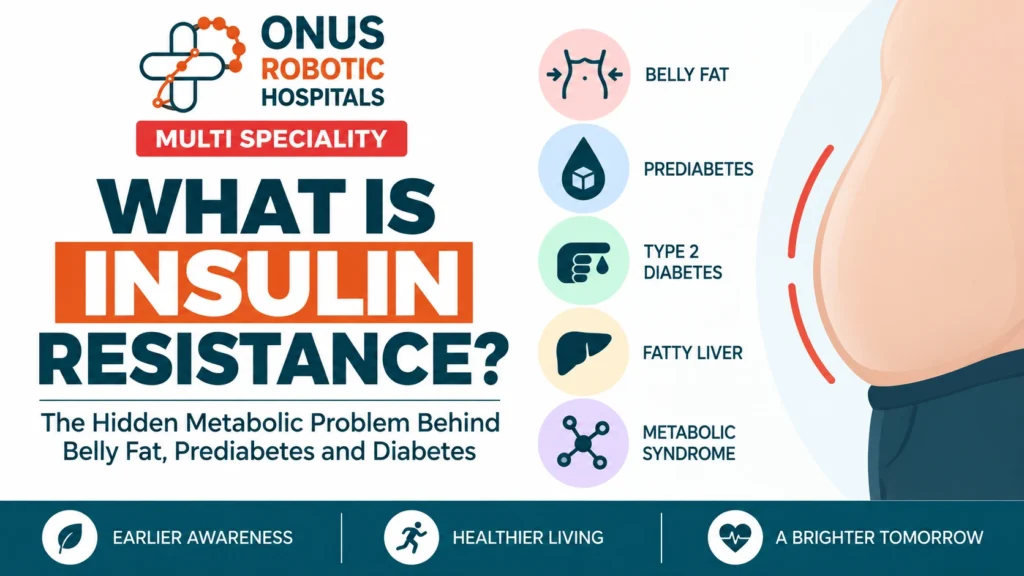
Insulin resistance is strongly associated with several common health conditions, including:
- Belly fat
- Prediabetes
- Type 2 diabetes
- Fatty liver disease
- High triglycerides
- Obesity
- Metabolic syndrome
The challenge is that insulin resistance often develops silently, without obvious symptoms. By the time blood sugar levels begin to rise consistently, significant metabolic changes may already have occurred.
The good news is that insulin resistance can often be improved through lifestyle changes and appropriate medical guidance, especially when detected early.
What Is Insulin?
Insulin is a hormone produced by the pancreas.
Its primary role is to help glucose (sugar) move from the bloodstream into the body’s cells, where it is used as a source of energy.
A normal process looks like this:
Food → Digestion → Glucose enters bloodstream → Pancreas releases insulin → Cells absorb glucose
When this system works efficiently, blood sugar levels remain within a healthy range.
What Is Insulin Resistance?
Insulin resistance occurs when the body’s cells become less responsive to insulin.
As a result, the pancreas must produce larger amounts of insulin to help glucose enter the cells.
Initially, blood sugar levels may remain normal because the pancreas compensates by making extra insulin.
Over time, however, the pancreas may struggle to keep up with the increasing demand.
This may lead to:
Insulin Resistance → Prediabetes → Type 2 Diabetes
While not everyone with insulin resistance develops diabetes, the risk increases significantly when insulin resistance persists for years.
A Simple Way to Understand Insulin Resistance
Think of insulin as a key and your cells as locks.
Normally:
Insulin (Key) → Opens Cell (Lock) → Glucose Enters
With insulin resistance, the lock becomes less responsive.
The body responds by producing more keys (insulin).
This means a person may have:
- Normal blood sugar
- Elevated insulin levels
for many years before diabetes develops.
What Causes Insulin Resistance?
There is no single cause.
Several factors contribute to the development of insulin resistance.
1. Excess Visceral Fat
Fat stored around internal organs is strongly linked to insulin resistance.
This type of fat is commonly referred to as belly fat or visceral fat.
2. Physical Inactivity
Muscles help use glucose for energy.
When physical activity decreases, insulin sensitivity may also decline.
3. Excess Calorie Intake
Long-term overeating can contribute to weight gain, visceral fat accumulation, and metabolic dysfunction.
4. Genetics and Family History
Some individuals are genetically more susceptible to insulin resistance and Type 2 diabetes.
5. Poor Sleep
Insufficient or poor-quality sleep can negatively affect insulin sensitivity and appetite regulation.
6. Increasing Age
As people age, muscle mass often decreases while body fat increases, contributing to metabolic changes.
7. Medical Conditions
Certain conditions are associated with insulin resistance, including:
- Polycystic Ovary Syndrome (PCOS)
- Metabolic Fatty Liver Disease
- Obesity
- Metabolic Syndrome
Why Belly Fat Matters
Not all body fat behaves the same way.
Visceral fat is particularly important because it surrounds internal organs and is metabolically active.
Excess visceral fat has been linked to:
- Chronic inflammation
- Insulin resistance
- Fatty liver disease
- Abnormal cholesterol levels
- Cardiovascular disease
This is why waist circumference is often a useful indicator of metabolic health.
Can Thin People Have Insulin Resistance?
Yes.
This is especially common among South Asian populations.
A person may have:
- Normal body weight
- Normal BMI
yet still develop:
- Excess abdominal fat
- Visceral fat accumulation
- Insulin resistance
- Prediabetes
This highlights an important point:
Being thin does not automatically mean being metabolically healthy.
Why Are Indians at Higher Risk?
South Asians have a higher tendency to develop:
- Insulin resistance
- Type 2 diabetes
- Belly fat
- Metabolic syndrome
- Heart disease
These metabolic abnormalities can occur at lower body weights compared to many other populations.
This makes early screening particularly important.
Symptoms of Insulin Resistance
One of the biggest challenges is that insulin resistance often causes no obvious symptoms.
Some people may notice:
- Increasing waist circumference
- Difficulty losing weight
- Increased hunger
- Fatigue
- Darkening of the skin around the neck or armpits
However, symptoms alone cannot diagnose insulin resistance.
What Is Acanthosis Nigricans?
Acanthosis Nigricans is a skin condition characterized by:
- Darkened skin
- Thickened texture
- Velvety appearance
It commonly appears around:
- Neck
- Armpits
- Groin
This condition may be associated with insulin resistance, particularly in people with obesity.
How Is Insulin Resistance Diagnosed?
There is no single test that definitively diagnoses insulin resistance in routine clinical practice.
Doctors typically evaluate the overall metabolic picture using:
- Fasting Blood Sugar
- HbA1c
- Lipid Profile
- Waist Circumference
- BMI
- Blood Pressure
- Liver Function Tests
- Medical History
In some cases, fasting insulin levels and specialized metabolic assessments may also be considered.
What Is HOMA-IR?
HOMA-IR stands for:
Homeostatic Model Assessment of Insulin Resistance
It uses fasting glucose and fasting insulin levels to estimate insulin resistance.
Although useful in certain clinical situations and research settings, HOMA-IR should always be interpreted within the broader clinical context.
Insulin Resistance and Prediabetes
Prediabetes occurs when blood sugar levels are higher than normal but not yet in the diabetic range.
Insulin resistance is often one of the main driving factors.
The progression can be simplified as:
Insulin Resistance → Increased Insulin Production → Prediabetes → Type 2 Diabetes
Fortunately, early intervention may slow or prevent this progression.
Insulin Resistance and Fatty Liver Disease
Insulin resistance and fatty liver disease frequently occur together.
When excess fat accumulates in the liver, metabolic dysfunction often worsens.
Improving insulin sensitivity through weight management, exercise, and healthy nutrition may help reduce liver fat and improve overall health.
Insulin Resistance and PCOS
Insulin resistance is common in women with PCOS.
It may contribute to:
- Weight gain
- Difficulty losing weight
- Menstrual irregularities
- Increased risk of Type 2 diabetes
Women with PCOS often benefit from individualized metabolic assessment and treatment.
Can Insulin Resistance Be Improved?
In many individuals, insulin sensitivity can improve significantly through lifestyle changes.
Important strategies include:
Weight Management
Reducing excess body fat, particularly visceral fat.
Regular Exercise
Both aerobic activity and strength training improve insulin sensitivity.
Healthy Nutrition
Balanced meals that include protein, fibre, vegetables, and appropriate portions.
Better Sleep
Aim for approximately 7–9 hours of quality sleep.
Stress Management
Reducing chronic stress may support better metabolic health.
Why Exercise Is One of the Most Effective Tools
Exercise helps muscles absorb glucose more efficiently.
Beneficial activities include:
Walking
Simple, accessible, and effective.
Aerobic Exercise
- Brisk walking
- Cycling
- Swimming
- Jogging
Strength Training
- Resistance bands
- Bodyweight exercises
- Dumbbells
- Weight machines
Building muscle helps improve the body’s ability to regulate glucose.
What Should You Eat If You Have Insulin Resistance?
There is no single “insulin resistance diet.”
A balanced approach focuses on:
Protein
- Eggs
- Fish
- Chicken
- Dal
- Paneer
- Tofu
- Curd
Vegetables
Should form a major portion of meals.
Fibre
- Fruits
- Whole grains
- Pulses
- Nuts
- Seeds
Healthy Fats
Consumed in appropriate portions.
Carbohydrates
Choose quality carbohydrate sources and monitor portions.
Do You Need to Stop Eating Rice?
No.
Rice can still be part of a healthy diet.
A practical approach may be:
- Moderate rice portions
- More vegetables
- Adequate protein
Sustainable dietary changes are generally more effective than completely eliminating traditional foods.
Don’t Wait for Diabetes to Develop
If you have:
- Belly fat
- Prediabetes
- Fatty liver
- High triglycerides
- PCOS
- Family history of diabetes
- Increasing waist circumference
it is important to address metabolic health early.
Prevention is often easier than treating established diabetes.
A Simple 30-Day Plan to Improve Insulin Sensitivity
Week 1
Reduce sugary drinks and sweetened beverages.
Week 2
Walk for 10–15 minutes after meals.
Week 3
Add resistance training 2–3 times per week.
Week 4
Review protein intake, fibre consumption, portion sizes, and calorie balance.
Continue these habits beyond the first month for lasting benefits.
Conclusion
Insulin resistance is often a silent metabolic warning sign.
You may feel healthy today and still be at risk for future metabolic problems.
The encouraging news is that insulin sensitivity can often be improved through:
✔ Weight management
✔ Regular walking
✔ Strength training
✔ Adequate protein and fibre
✔ Better sleep
✔ Stress management
✔ Reduced visceral fat
✔ Early metabolic screening
Don’t wait until your blood sugar reaches diabetic levels.
Addressing insulin resistance early may help protect your future health and reduce the risk of diabetes, fatty liver disease, and cardiovascular complications.
ONUS Robotic Multispeciality Hospitals
Dr. P. Ravi Kiran